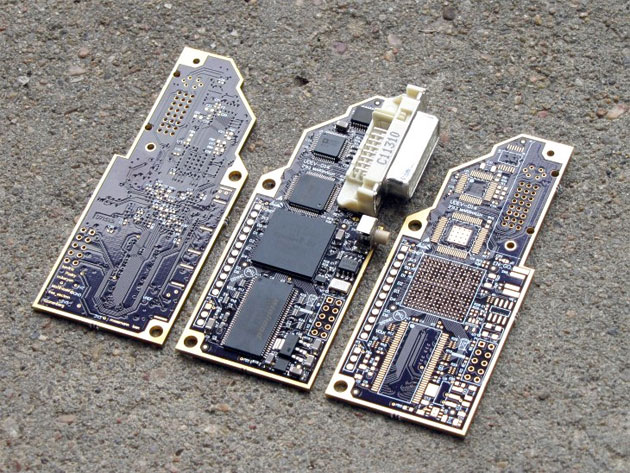
Nintendo 64 mod promises HDMI output, soldering burns


If you have a Nintendo 64 kicking around, it's probably not hooked up to your television. It's not that you don't love the classic console, it's just that many modern sets don't support the machine's archaic video cables. Don't worry, it can be fixed. RetroActive, a one-man mod team, is working on a circuit board that will gift the aging console with digital outputs. The kit promises to pipe audio and video out through DVI, HDMI or VGA (assuming you have the appropriate cables), but its creator is considering building an HDMI-only version. Either way, it won't be easy to install -- RetroActive says that it attaches directly to one of the Nintendo 64's main processors, and "it requires fine pitch soldering skills to install."

RetroActive has set up a notification page for folks interested in project, adding that the device's Q1 2014 release date is only tentative. "To be honest it's one of many things I have going on and I'd rather not release a crappy product," writes Marshall, the man behind RetroActive. "It'll be done when it's done." Fair enough, we're not that handy with a soldering iron anyway.


Text by ENGADGET
But SOURCE to build it HERE

Comments

Popular posts from this blog

So this is basically / Asi que esto es basicamente... [SPANISH TEXT]

Si amigos, basicamente la idea del blog fue introducir a todos en el mundo de la tecnologia y hacer que esta no fuera tan "compleja" o "complicada" para todos. Ultimamente no hago reviews propios, ya que me tomo la molestia de elegir buenas noticias (que considero) para su placer informativo (bueno, las visitas me dicen que lo estoy haciendo bien) Pero, y si algun dia llegase a terminar todo? Regalar el dominio? Vender el blog? Nah, muchas veces me lo he preguntado pero... por algo senti el deseo de escribirles, desde mi misma mano y tecla, porque esto es lo que me apasiona: la tecnologia, la programacion, el llevar todo niveles superiores, exponenciar mi capacidad de analisis. De esto se trata todo, esto es basicamente el alma del blog: tecnologia. Actualmente me encuentro en otra ciudad, desde hace ya 1 mes. Las cosas han estado normales, pues dentro de lo que alguien podria definir de "normal". Gracias a Dios no me hace falta lo basico, desafortunad...

Child-friendly Galaxy Tab 3 Kids listed in Korean brochure

We're no experts in Korean back-to-school literature, but it looks as if one retailer has tipped Samsung's plans a little early. If the documents above are legitimate, then the company will launch a kiddie-focused Galaxy Tab in short order. The Galaxy Tab 3 Kids is said to be an 8.5-inch slate with a 1.2GHz dual-core CPU, a 1,024 x 600 WSVGA display, 8GB storage, 1GB RAM and Jelly Bean. The company has also seen fit to include 802.11 a/b/g/n WiFi, Bluetooth 3.0, a microSD card slot (no word on capacity) and a 4,000mAh battery. One thing that lends weight to the listing is that the device's model number is SM-T2105, which evleaks tersely described as a "Galaxy Tab for children" a month ago. There's more pictures over at the source, but not a single spec saying that this new device is resistant to jam-smeared fingers. Source: ENGADGET

The Ford Fiesta 2011 Was the Budget Hacker’s Dream (And No One Noticed)

The Ford Fiesta 2011 Was the Budget Hacker’s Dream (And No One Noticed) If you ever drove a Ford Fiesta 2011 SE and felt like it had hidden potential, you weren’t wrong — it was a software-defined vehicle before that was even a buzzword . While most saw it as a humble economy car, tinkerers and enthusiasts quickly discovered that the Fiesta was actually modular, reprogrammable, and surprisingly future-proof . With the right tools (and a bit of nerve), you could unlock features typically reserved for higher trims, all with minor hardware tweaks and some clever software work. Here’s a deep dive into the hidden arsenal of the 2011 Fiesta — and why it deserves a cult status among modders. The Secret Weapon: Shared Architecture Ford built the Fiesta using a highly modular electronic architecture . Many trims — from the base SE to the Titanium — shared the same PCM, wiring harnesses, and core modules . That meant you could: Add hardware from higher trims (like steering wheel...