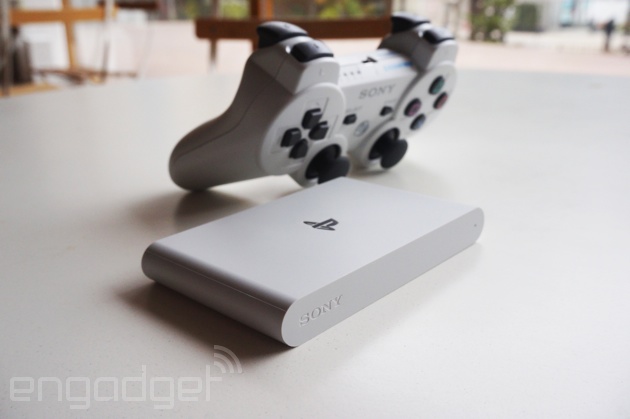
PlayStation Vita TV review: Sony's first mini-console has some growing pains


Sony had a tiny surprise to share just ahead of the Tokyo Games Show: the PS Vita TV, appearing from inside SCE President Andrew House's jacket pocket. Having already announced a new, slender PS Vita handheld less than an hour earlier, Sony showed off this minute console -- roughly the same footprint as a smartphone -- that plays Vita games, PlayStation games and streams video content, as well as music and video from Sony's own store. It can also connect with multiple PS3 DualShock controllers, allowing for proper, responsive gaming -- something we're not quite used to getting from something so tiny.

You could see it as a brutal counterstrike from the PlayStation team against the cheap, mini-console likes of OUYA and GameStick, even Huawei. Aside from contemporary Vita titles and indie games, you can also tap into an ever-increasing catalog of hits from yesteryear -- something that the Android and iOS platforms also dip their feet into, but with the peace of mind (read: stability) of PlayStation hardware, and the ability to steer the action with a DualShock controller. Sound like something you'd like to try out? Well, unfortunately, unlike the new PS Vita, this is currently a Japan-only deal. What's more, availability in Nihon is directly tied to compatibility there, too; you'll need a Japanese PSN account to even use it. We're still getting a vague line from SCE on whether it will eventually arrive outside of Japan. (It would be a convenient bit of hardware to sell alongside Sony's PlayStation Now streaming-game service, set to launch in the US later this year, right?)

So, is this just a tenuous experiment or a whole new console line for PlayStation? Or, given that it's practically got all the same internals, would you be better off just buying a Vita?


SOURCE

Comments

Popular posts from this blog

So this is basically / Asi que esto es basicamente... [SPANISH TEXT]

Si amigos, basicamente la idea del blog fue introducir a todos en el mundo de la tecnologia y hacer que esta no fuera tan "compleja" o "complicada" para todos. Ultimamente no hago reviews propios, ya que me tomo la molestia de elegir buenas noticias (que considero) para su placer informativo (bueno, las visitas me dicen que lo estoy haciendo bien) Pero, y si algun dia llegase a terminar todo? Regalar el dominio? Vender el blog? Nah, muchas veces me lo he preguntado pero... por algo senti el deseo de escribirles, desde mi misma mano y tecla, porque esto es lo que me apasiona: la tecnologia, la programacion, el llevar todo niveles superiores, exponenciar mi capacidad de analisis. De esto se trata todo, esto es basicamente el alma del blog: tecnologia. Actualmente me encuentro en otra ciudad, desde hace ya 1 mes. Las cosas han estado normales, pues dentro de lo que alguien podria definir de "normal". Gracias a Dios no me hace falta lo basico, desafortunad...

Child-friendly Galaxy Tab 3 Kids listed in Korean brochure

We're no experts in Korean back-to-school literature, but it looks as if one retailer has tipped Samsung's plans a little early. If the documents above are legitimate, then the company will launch a kiddie-focused Galaxy Tab in short order. The Galaxy Tab 3 Kids is said to be an 8.5-inch slate with a 1.2GHz dual-core CPU, a 1,024 x 600 WSVGA display, 8GB storage, 1GB RAM and Jelly Bean. The company has also seen fit to include 802.11 a/b/g/n WiFi, Bluetooth 3.0, a microSD card slot (no word on capacity) and a 4,000mAh battery. One thing that lends weight to the listing is that the device's model number is SM-T2105, which evleaks tersely described as a "Galaxy Tab for children" a month ago. There's more pictures over at the source, but not a single spec saying that this new device is resistant to jam-smeared fingers. Source: ENGADGET

The Ford Fiesta 2011 Was the Budget Hacker’s Dream (And No One Noticed)

The Ford Fiesta 2011 Was the Budget Hacker’s Dream (And No One Noticed) If you ever drove a Ford Fiesta 2011 SE and felt like it had hidden potential, you weren’t wrong — it was a software-defined vehicle before that was even a buzzword . While most saw it as a humble economy car, tinkerers and enthusiasts quickly discovered that the Fiesta was actually modular, reprogrammable, and surprisingly future-proof . With the right tools (and a bit of nerve), you could unlock features typically reserved for higher trims, all with minor hardware tweaks and some clever software work. Here’s a deep dive into the hidden arsenal of the 2011 Fiesta — and why it deserves a cult status among modders. The Secret Weapon: Shared Architecture Ford built the Fiesta using a highly modular electronic architecture . Many trims — from the base SE to the Titanium — shared the same PCM, wiring harnesses, and core modules . That meant you could: Add hardware from higher trims (like steering wheel...